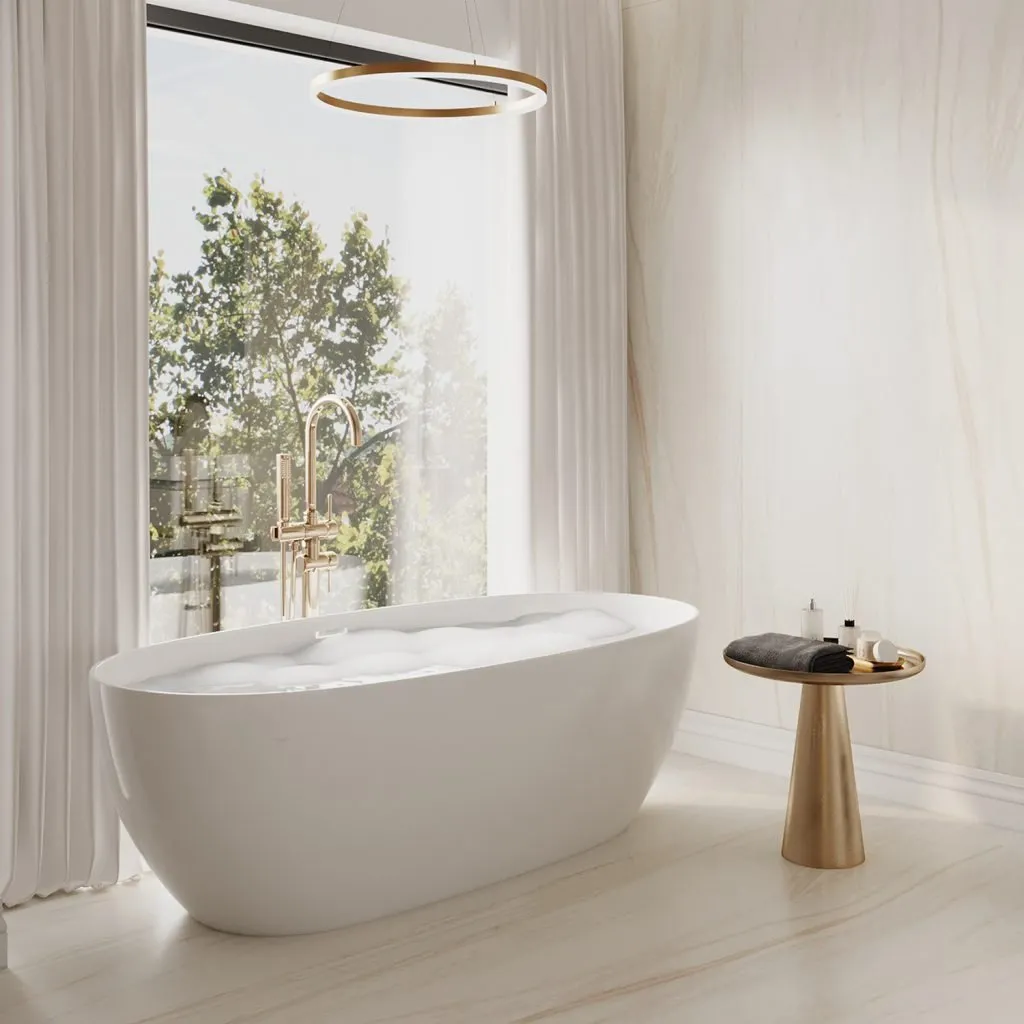
Committing to a sprawling 67-inch freestanding bathtub is a significant logistical undertaking. The installation requires structural floor reinforcement, advanced plumbing bypasses, and heavy lifting. Yet, homeowners regularly undermine this immense architectural investment by choosing the wrong foundational material for the tub itself. Currently, the industry faces a binary decision: The cheaper, lightweight Acrylic sheet tub, or the massive, dominant Solid Surface Stone Resin.
The Acrylic Downfall: Flexibility and Heat Loss
Acrylic bathtubs are created by taking a thin sheet of plastic acrylic, vacuum-forming it over a heated mold, and backing it with fiberglass spray for rigidity. They are exceptionally light (often under 80 lbs) and inexpensive.
However, acrylic possesses two catastrophic flaws for luxury soaking:
- Thermal Insulation Collapse: Thin plastic possesses almost zero thermal mass. When you fill an acrylic tub with scalding 110°F water, the ambient air immediately sucks the heat through the thin walls. Your relaxing soak will turn freezing cold in less than 20 minutes.
- Hollow Acoustics and Flex: Even when reinforced, stepping into an acrylic tub sounds "hollow" or squeaky. The floor pan physically bends and flexes under the user's weight, completely destroying the illusion of high-end luxury.
Solid Surface Stone Resin: The Ultimate Thermal Battery
By stark contrast, TWALSU Solid Surface bathtubs are aggressively over-engineered. They are created by pouring a viscous mixture of crushed natural stone (bauxite rock) blended with highly durable binding polymers into a high-pressure mold. The result is a single, continuous, non-porous structure weighing upwards of 300 to 400 lbs empty.
1. Thermostatic Soaking Dominance
Unlike plastic, stone resin possesses immense thermal mass. This heavy material absorbs the heat from the hot water and acts as an enormous radiator, bouncing that heat back into the tub. This allows you to soak comfortably for over an hour without continually draining and refilling the hot water supply.
2. Matte Finish vs Gloss Reflections
Acrylic can only exist in a highly reflective, glossy finish that scratches easily and highlights water spots. TWALSU stone resin is celebrated for its signature "velvet matte" finish. This ultra-smooth, matte white texture completely resists yellowing from UV light, is naturally anti-bacterial (due to zero microscopic pores), and if severely scratched, can literally be sanded down and buffed out to brand-new condition in minutes with standard sandpaper—a feat impossible with plastic.
While stone resin commands a higher initial price point and requires more manpower to install, its permanent durability spanning well over half a century makes it the only viable choice for serious master suite renovations and five-star commercial hospitality developments.